-
2LL3 Activity 3
Post Structuralism
Michel Foucault’s theory applies to our modern day society so well it is almost uncanny – One of the key arguments involves policing and control – individuals can be essentially conditioned to “police” themselves through systematic and often subtle reinforcement periods (i.e., posts about risks of legal troubles should an individual pirate content off the internet can creep its way into someone’s head and eventually discourage them from doing such acts, in reality their chance of an arrest is no higher now than before, but they choose to avoid it as assurance.) The nature of these “posts” or recommendations can often be deceiving – as the BBC video pointed out, subtle reinforcements here and there, and all it takes is a little time before an individual becomes conditioned without knowing it. Be it a post causing distress, or a post making someone very angry or happy at something, social media can almost certainly be used – and it probably is – as a tool for control, or at the minimum a device for imposing external influence on the masses. Yes, the individual is making their decisions, but to what degree?
Post Modernism
Postmodernism has meaning for Judith Butler personally. Judith Butler, in contrast, applies the skepticism of postmodernism to our own bodies and sexuality. She has had a significant impact in challenging the fundamental tenet of feminism, which holds that sex differences between men and women are biologically based. Instead, she places a strong emphasis on gender performance, mirroring postmodernist ideas. She contends that rather than being determined by the biology of our own bodies, our sense of gender identity is created and maintained by this performance. In order to comprehend sexuality and sexual preferences, Butler uses parallel thinking. For example in today’s world Butler emphasizes walking and speaking in ways that consolidate an impression of being a male or female. Thus according to postmodernism, the value of the performance (or presentation, to use Butler’s word) has superseded that of the reality being shown. Nothing, according to some, is more tangible and real than our own bodies. Butler, however, argues that our experience of gender is not based on the physiology of our bodies. In today’s culture, it affects our gender identity through influencing how we present gender in every contact, every day.
Comparison and Conclusion
Both of these theories relate to each other when analyzing the ‘truth’. To Foucault, the absolute truth claimed by the state is not actually the truth but a tool to gain and exercise power over other people. His denial of the objective truth directly talks to Judith Butler’s beliefs. She believes truth varies person to person which indicates Foucault’s theory of the non-existent truth. Because if postmodernism is all about personal beliefs then every individual is making up their own truths. For instance, she believes people are not born with a gender, they create it for themselves. But for people who believe in absolute truths unlike Butler would argue that people have certain genders from the moment they are born. In this way the intriguing question arises ‘Who’s truth is absolute truth and why?’. Micheal Foucault had also raised the same question while analyzing the truth.
In summary, both argues and reacts to the notion that society should operate under a defined set of systemic standards, while post structuralism approaches it much more academically with theories such as panopticism and distribution of knowledge, post modernism would expresses these ideas in the form of art. Be it visual or auditory, since it concerns a lot more with the way we view the world, a lot of it through media.
-
2LL3 Activity #2
Module 5&6:
Goffman and the performed self;
Interview with Peter. L. Berger.
Symbolic interaction studies the relationships between people in society. Goffman created dramaturgy, in which he divided the self into two parts, the front and the back. Goffman focuses more on and explores “the actual, physical copresence of individuals–the interaction order–shapes the organization of the self.” Goffman’s theory can help us understand the true feelings of others in contemporary society. For example, when parents have problems in educating their children, perhaps parents should take some measures to let the children step down from the “stage” when they get along with their parents and return to the backstage. Understand the problem and participate in the children’s perspective.
Phenomenology is a philosophy that deals with lived experiences that an individual has and not specifically a sociological subject. It dives into how experiences and objects hold different meanings and values based on the subjective view of an individual. This is highlighted in the “Interview with Peter L. Berger on The Social Construction of Reality” where the author of the book “The Social Construction of Reality” argues in it the importance of knowledge of all forms in sociology famously stating “if the sociology of knowledge s to live up to its title, it should concern itself with everything that passes for knowledge in society” and expanding on this by saying “the consciousness of a philosopher is no more interesting to that of the consciousness of a taxi driver”. These connections can help us appreciate others’ perspectives and understand that our views on subjects and objects are subjective, especially when looking at different classes, cultures, etc.
Both theories focus on individual level, subjective understanding of the world, and how it shapes their perception and behavior. One creates meaning; the other tries to comprehend it. The two theories differ in the level & nature of their study – symbolic interactionism focuses on micro level, person to person interactions whereas phenomenology is concerned with the individual itself – reaching as deep as studying perceived reality vs. objective reality. In short, phenomenology is much more abstract compared to interactionism.
Despite their differences, they can be incorporated/applied together into studies where context is lacking – for example, when studying a particular culture, symbolic interactionism is used when communications are observed – through which we may extract certain symbols, slangs, gestures and such; and when we are interviewing members of said culture we may utilize phenomenology to gather their perception of such slangs, gestures, as well as how they perceive “outsiders”. We can take individual responses and make comparisons with others’ responses to “arrive” at a meaning.
To conclude, although interactionism is a much more physically involved theory involving multiple individuals whereas phenomenology is much more philosophical and abstract in nature, they both study individual perception and action, and can often be used together in studies.
-
2LL3 Group Activity 1 – Group 16
Chosen Medias from Module 2,3,4:
Interview with Robert. K Merton;
Social Capital Theory;
Radical thinkers: Max Horkheimer’s Critique of Instrumental Reason.
Stephen Cao: Robert K Merton & modern day anomie:
Robert K. Merton expanded upon the concept of anomie, which is a state of social instability caused by one, or a combination of: social change, social uncertainty, or a lack of shared norms and values. Originally composed by Emile Durkheim in “suicide”, Merton’s addition to anomie describes a society in which common goals are hard or impossible to achieve, which results in an increase in deviant behaviors. Current examples of anomie in Canada include: Rising costs of necessities means people have to work harder than usual while some cannot even secure a job, effectively preventing them from achieving their life goals for an uncertain period of time. This may be linked to the rise in deviance as crime rates have sky-rocketed since covid, and violent crimes continue to increase (e.g. TTC attacks, Recent bus attack which killed two young children).
Xinlei Wang: Social Capital Theory:
On the other hand, James S. Coleman’s Social Capital theory highlights the connections between social networks and their impact on individual and collective outcomes. According to Coleman, social capital is generated through trust, shared values, and norms of reciprocity among individuals and groups. In Canada, this theory can help us understand the role of social capital in shaping access to resources and opportunities. Also, the theory of social capital can help us understand some of the political consequences. For example, voter turnout and citizen participation are very important for formulating policies that support social equality and promote inclusive growth when understanding the role of social capital formation results.
Arina Hossain: The connection between the two theories:
Robert. K Merton’s expansion on Anomie and the social capital theory shares an appealing relationship. This relationship also helps us understand the reason behind the increasing rate of deviant behaviors in today’s contemporary social world. Merton’s theory helps us realize that in a state of anomie, a group of people is usually blocked from the societal means for structural reasons. For instance, people who are born in poverty cannot get access to higher education for financial instability. But as social beings like their other social capital networks, they would still want to achieve societal goals. Being financially stable is a societal goal in our recent social contemporary world. As the poverty-stricken people cannot achieve social goals in a normal way due to poverty, they achieve those through deviant behaviors. They are also maximizing the reward from accessing the resources through social capital. According to James Coleman, a social actor is a ‘rational, purposive agent motivated by maximizing rewards’. So, it can be said that they are well socialized and within the topology of social capital. These people utilize their social capital connections in a deviant way instead of socially acceptable way. An example to mention here would be the incident that occurred on January 23, 2023 in TTC. A man grabbed a woman’s purse at Broadview station during a violent robbery. The suspect fled with the item. Thus, this important issue can be well understood through Robert K. Metron’s and James Coleman’s viewpoints.
Mckayla Styles: Robert K. Merton Functional View on Society
Robert K. Merton, a well-known thinker in the latter part of the twentieth century, adopted a functional view of society. Merton is renowned for his “middle-ranged theorizing,” which refers to ideas that make factual and precise assertions about society. Merton looked at social institutions to investigate if and how they benefited society rather than presuming that they are integrated to satisfy functional imperatives. Societal institutions are components that keep society functioning. Since they make society work, they are seen as being significant. For instance, as a social institution, the education system serves the purpose of educating the younger generations and preparing them for the workforce. But Merton also believes that the time spent in school creates the opportunity for youth gangs to form and the participation in deviant acts.
Dragos Voica: Radical thinkers: Max Horkheimer’s Critique of Instrumental Reason:
The multimedia “Radical thinkers” directly applies Max Horkheimer’s worries of the individual to an open-air market in London. The video equates Horkheimer’s fears of the decline of individuality to the history of “Camden Locks”. A place once thought to be a counter culture (individuality). However as time passed, the market became more tailored to the mainstream thus losing its original identity in the masses. This expresses Horkheimer’s fear of the new mass culture adding more strain to individuality. Real life examples can be seen in punk/alternative rock bands that become very popular and sell out or change the messages in their songs to better fit the culture they were countering. This concept connects with the other two theories as they focus on the relationship between the individual and the collective. Modern day anomie looks to explain the rise in deviance caused by social change/lack of common values and social capital seeks to highlight the connections between people. These come together in Horkheimer’s fear of the individual losing himself to the collective.
-
Blog Post 3 – Voluntourism and Donations
There is a difference between travelling for work and travelling for tourism. This difference lies within the desire behind this drive to travel – One is serious business, the other is a fun time. Sometimes, elements of the two are mixed in but at the end of the day, if you’re having a good time, who cares? Unless, you’re “on the other side”.
Articles about orphanages reminded me of the vietnam war or any war for that matter – When you’re soaked enough in one-sided information, you become blind to reality. Sometimes you’re fighting for a solution to a non-existent problem; Sometimes, intervention is a bad deal.
Although many see volunteering as a good deed, and that donations will hopefully help those in dire need, what they don’t realize is that in reality, they’re helping a business. A business modelled off moral support and profits form it. Examples are vast, aside from orphanages, the most simple (and unfortunately popular) form of such schemes is crowdfunding donations.
Just like orphanage businesses, these pages get donations from people in the name of charity, claiming that all of the money collected goes to those affected. The issue is, such webpages takes minutes to setup, requires virtually no backing whatsoever, and are accessible to everyone. How would you know, out of a thousand crowdfundings to help arctic foxes, which one is real and which ones aren’t?
Nothing is wrong with wanting to help. The problem is helping blindly, contributing without validating can be just as damaging. After some major scams, crowdfunding pages have begin improving their validating system, but for foreign governments, it is up to them whether to take action on these supposed institutions. Moral of the story is, anything can be turned for profit. Afterall, money makes the world go around. What we, as citizens of the world should do, is make sure that these money come from clean efforts. An extremely challenging task, but definitely worth trying.
-
Globalization Blog Post 2
Covid and Globalization
This post is inspired, and adds to the Faiola article.
Ever since covid struck, the world has never been the same. Some countries opened up, others remained in lockdown, and some adopted a mixed approach to a certain effectiveness. However, all of them, at some point during this everlasting ordeal, had imposed travel restrictions.
It doesn’t matter how easy virtual communications are, travel will always be the most valued form of relaying and receiving information. I was in China during the first 2 years of covid from 2020 to 2022. And during these times, despite intense restrictions and quarantines, I saw representatives from the UK, Canada, and other parts of the world attending business conferences in person. Although much less common during covid, it shows just how dependent countries have become on each other when it comes to trade and development, even when faced with a surge of nationalism. And this brings up an important topic –
If it weren’t for the ease of travel, covid would not have spread this quick; If countries did not care about what others’ are doing, we wouldn’t need to travel this much. Effectively speaking, travel enhancements, a product of globalization as much as a driving force of it, caused it to slow to a halt. Is it causing itself to de-globalize? Is globalization an inevitable, but also unstable force? These are questions we would usually ask ourselves. But at the same time, without scientists and doctors and the WHO, could it have been worse? That would be a topic for another blog.
Either way, the pandemic has been very effective at cutting down globalization especially in the form of travel. Here is a photo I took while waiting for a flight to hong kong. It was taken in the summer of 2022, in what was usually the busiest airport in my home province.
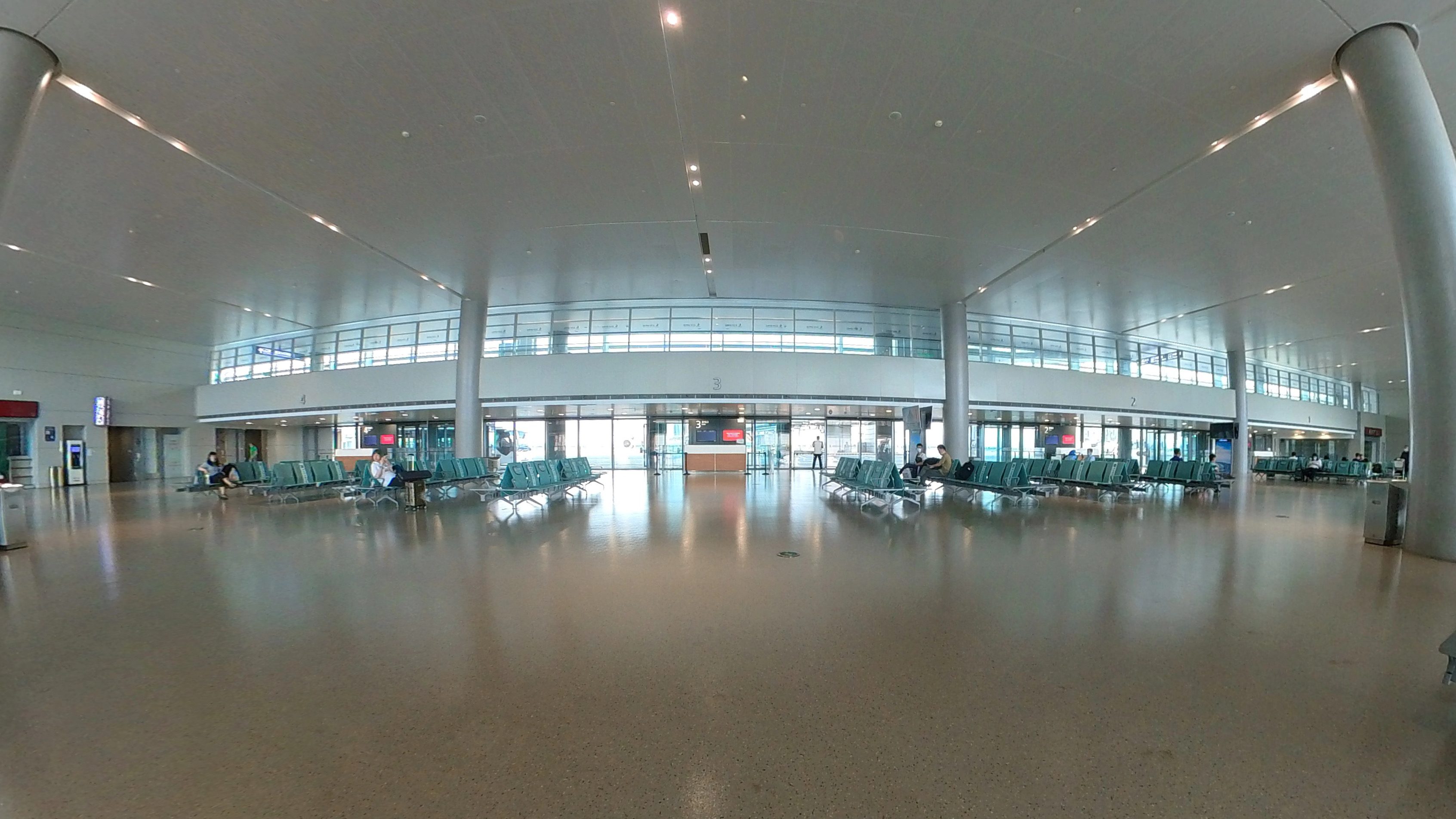
Outgoing flights were cut down to two per month, and still, the plane was mostly empty when I flew. Even coming back to Canada, the airports felt, wrong. It was almost liminal. Spaces usually filled with people, sound of chatter, footsteps, gone. Dim lights filled empty hallways. A grim reminder of what a globalized pandemic is capable of.
-
Project TreeCam
TreeCam – Trailer
Story of TreeCam
Discovering a Problem
I was practicing field archery at my local range, which is situated in a forest in rural Ontario when I decided I should film some cool footage of me practicing. I then spent the next 10 minutes finding a place to set my phone down without it falling over, only to find the resulting camera angle and footage useless. That’s when I had a thought –
When filming any footage outdoors tripods are usually used. The tripod offers three features:
- Stability – it has three points of contact, which prevents shifting and vibrations caused by the environment.
- Adjustability – Tripods can be adjusted on all three axises, giving you lots of potential camera angles.
- Flexibility – you can place it anywhere, even on rugged terrain, while ensuring the camera is securely mounted.
The problem is, bringing a tripod on a 5km hike not only adds weight, it also wears you down. Cheap tripods (~50 dollars) are heavy; Whereas expensive tripods (often exceeding $800!) are only marginally lighter. Therefore, a lighter, cheaper alternative is desired.
Inspiration & Solution
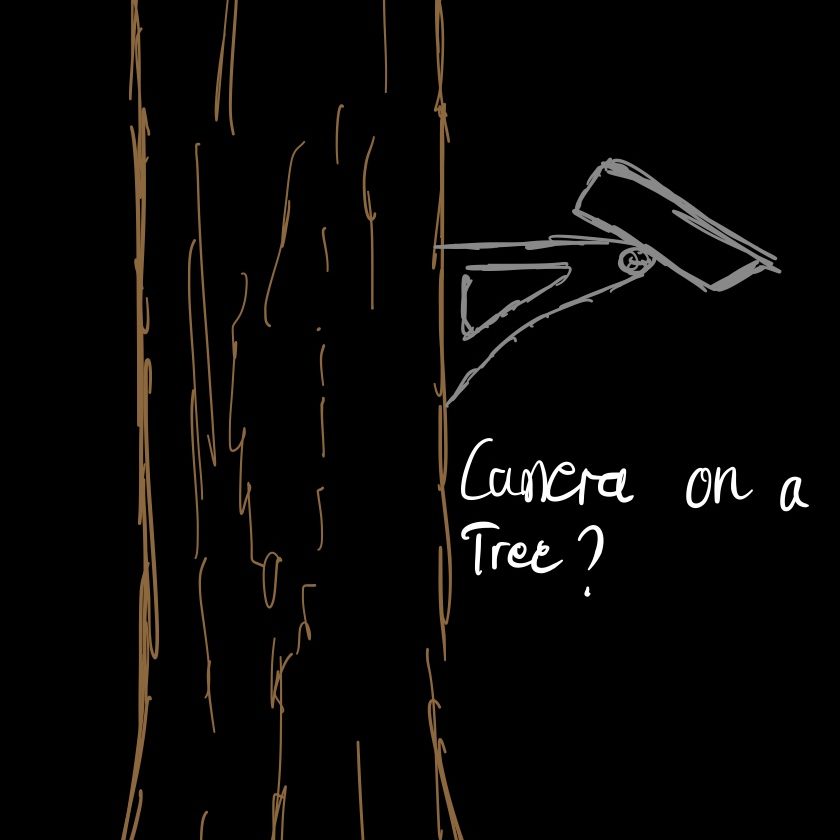
Being in the middle of a forest, I realized I could just use the trees as my tripod base, since it fulfills two criteria the tripod has: stability and adjustability. Trees are pretty solid, we can adjust the height by simply moving our camera higher or lower, and we can change the angle by rotating the camera along the tree. This leaves us with the third criteria, which is flexibility – how do we quickly change camera placement, from tree to tree?
The answer is simple, by making the process of installing the camera and uninstalling it quicker, we essentially create flexibility.
Therefore, if I can find a way to connect and disconnect the camera to any tree in a quick and secure way, I essentially get all the benefits of a tripod, without the weight and cost of one.
Design Objectives
After careful consideration, I decided, in order for this project to be successful, it must meet three objectives:
- The component must be lightweight and compact – it should fit in a pocket/backpack without taking much space and weight.
- The component must be easy and quick to deploy – it should be able to mount and dismount from a tree in seconds.
- The component must be flexible. – It should offer you lots of room for adjustment when it comes to camera angles.
The Project will follow the following procedures:
- Concept Brainstorm
- Product Design
- Product Manufacturing
- Product Trials
- Conclusion
Brainstorming a Design Approach
Trees are simple objects, they are essentially tubes with varying diameters which has a rough, grippy surface.
The initial idea was to use some kind of claw to instantly grip the camera rig onto the tree. This is the fastest way to Mount and dismount, but it requires sharp metal. Sharp metal means it will need a safety cover, which adds weight. It is also more costly to produce. Therefore this concept was ditched.
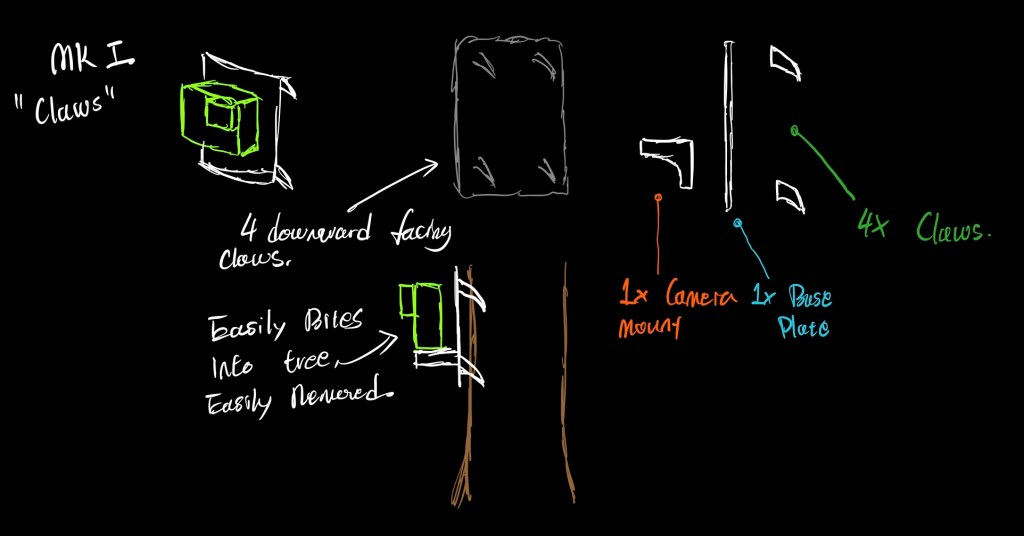
Fig. 2: Initial Design
The second idea is much more realistic, it involves an adjustable strap of some sorts which belts around the tree, the camera is then installed on the strap. This design also allows the user to quickly strap a camera onto a tree at a height and angle they desire.
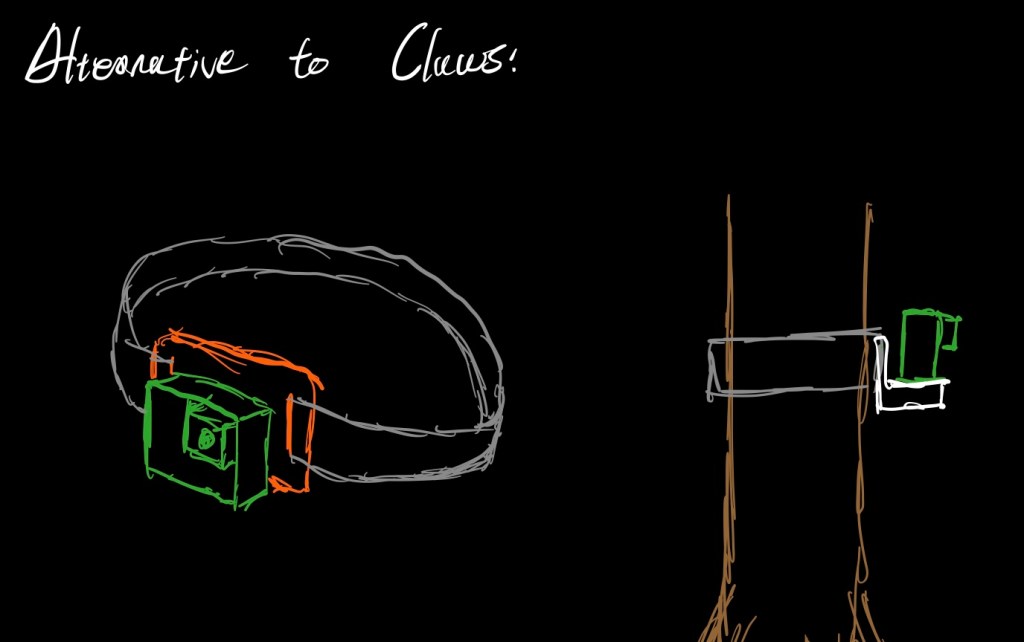
Fig.3: Second Sketch
However, this raises a question: How are we going to mount the camera onto the strap?
- There are many ways to film, the most common way is through a phone, or an action camera, which offers a larger sensor and has better slow motion capabilities
- Neither of them use the same mounting methods (phone requires a spring loaded clip, whereas an action camera often use their own proprietary method of mounting.)
To keep things simple, I decided the best mounting system to use is a GoPro style mount. GoPro action cameras are extremely popular and, a lot of attachments have been made to be compatible with them, including phone mounts. Therefore, we are effectively remixing by combining the GoPro system into our own design.
Design process
With mounting figured out, now it’s time to determine how we are going to put everything together. And it is rather simple. Strap goes on tree, we design a component that connects the camera to the strap, using GoPro’s system. For convenience, we will refer this component as the strap mount.
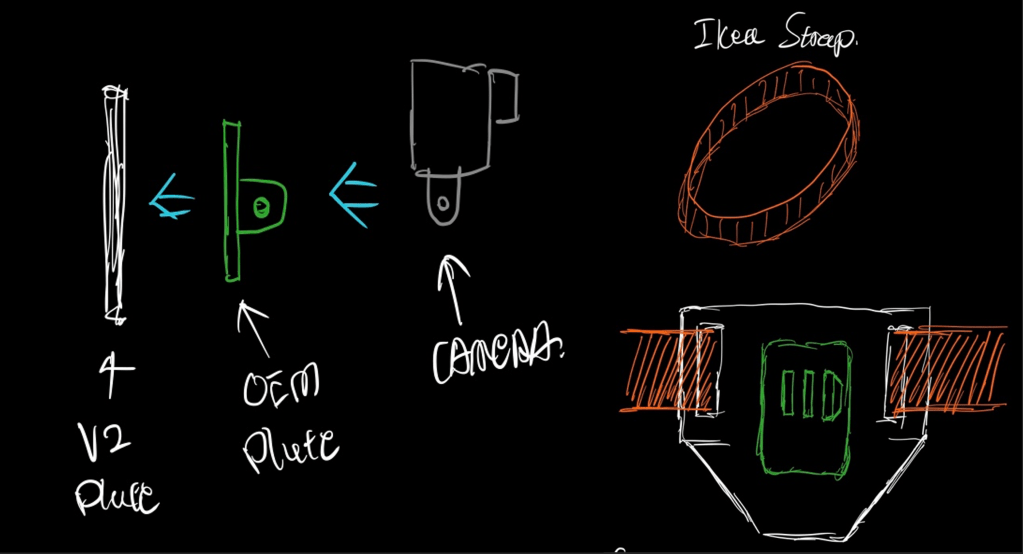
Fig.4: Components of the strap mount. Fig.5: Front view of Cam Mount
We have two objects which are already available: A Velcro strap which came from the packaging of an ikea mattress; and a couple of gopro receiver mounts (Referred in Fig.4 as “OEM Plate”). Given the insane amount of accessories GoPro produces, a tree strap, or one that’s potentially compatible, is not one of them. So we have to either glue or screw an existing GoPro receiver mount onto our strap mount/base plate. See Fig.4.
To attach the mount onto the ikea strap, we simply make a cutout on two sides of the plate and run the belt through. See Figure 5. The camera sits lower than center to compensate for potential deformation of the cardboard. Theoretically, if the camera is mounted too high, or level with the belt, it has the potential to twist the belt and rotate downwards, lowering its center of gravity prevents that from happening. See Figure 6&7.
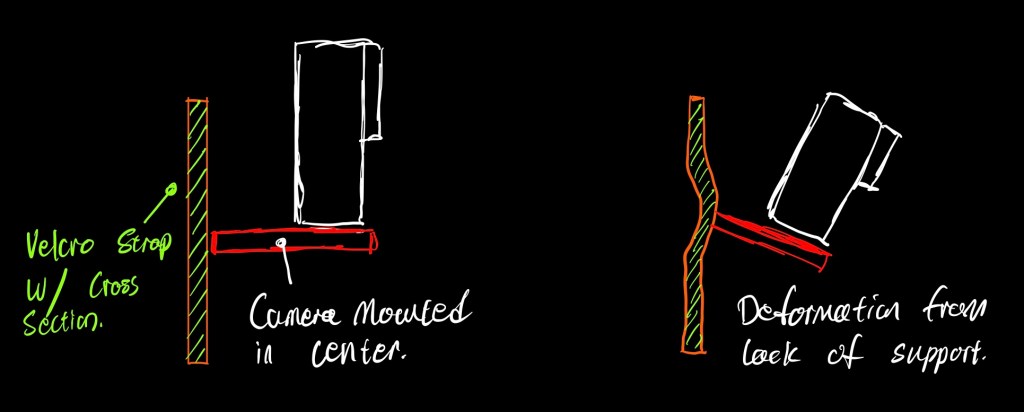
Fig.6. Diagram of deformation
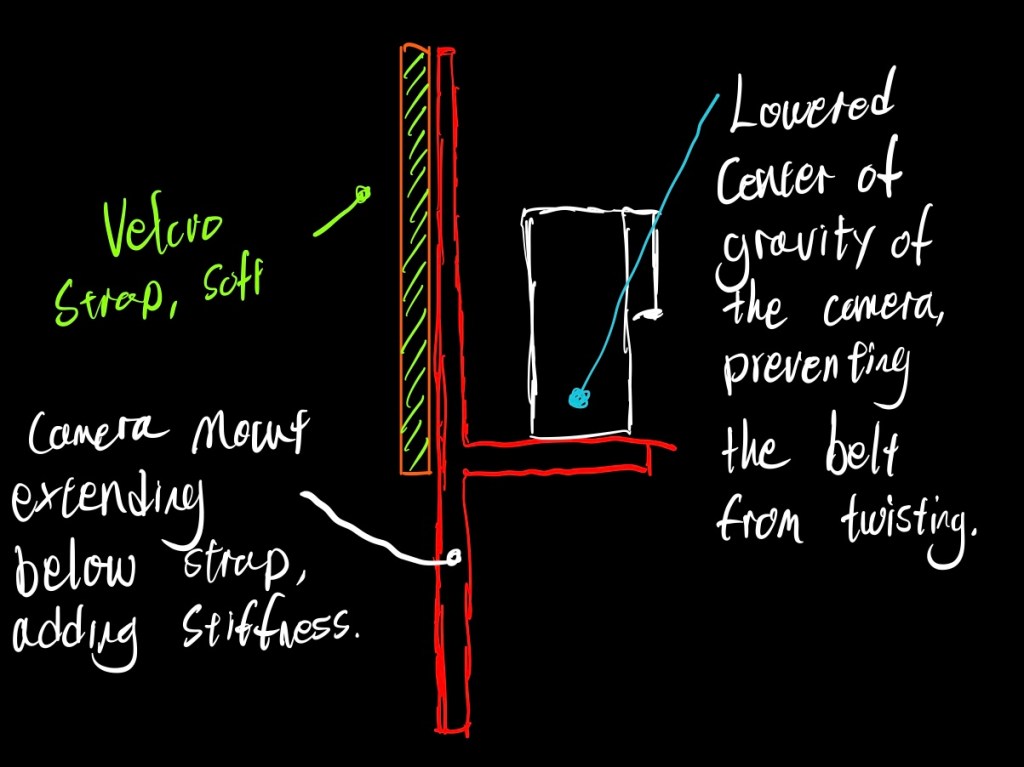
Fig.7: Design changes to prevent strap from twisting.
As such, this design configuration of the treecam will be composed of the following parts:
- An Ikea Strap
- A section of a bungee cord *Added during production, refer to Fig.10-12
- A piece of cardboard/cardboard like material
- A gopro receiver mount
- A piece of 3M double sided tape
Limitations
The first limitation surrounds fabrication, this component was originally planned to be 3d printed as that allows it to be one piece, saving more weight and bulkiness. Since that was not allowed, we are using cardboard instead.
The second limitation is a result of the first – if I am only allowed to use basic tools for manufacturing, the materials available would be restricted as a result, materials such as corrugated plastic or metal are out of the equation and I am basically left with just cardboard and the likes. This poses potential strength issues on the product. But as we will see in later sections, this weakness can be fixed.
Fabrication Process – MK1
In order to produce an accurate cut-out without industrial equipment such as a cnc, laser cutter or 3d printer, I printed out the design on a piece of paper with the correct scale, then used that as a trace template to cut out a piece of cardboard from a box.
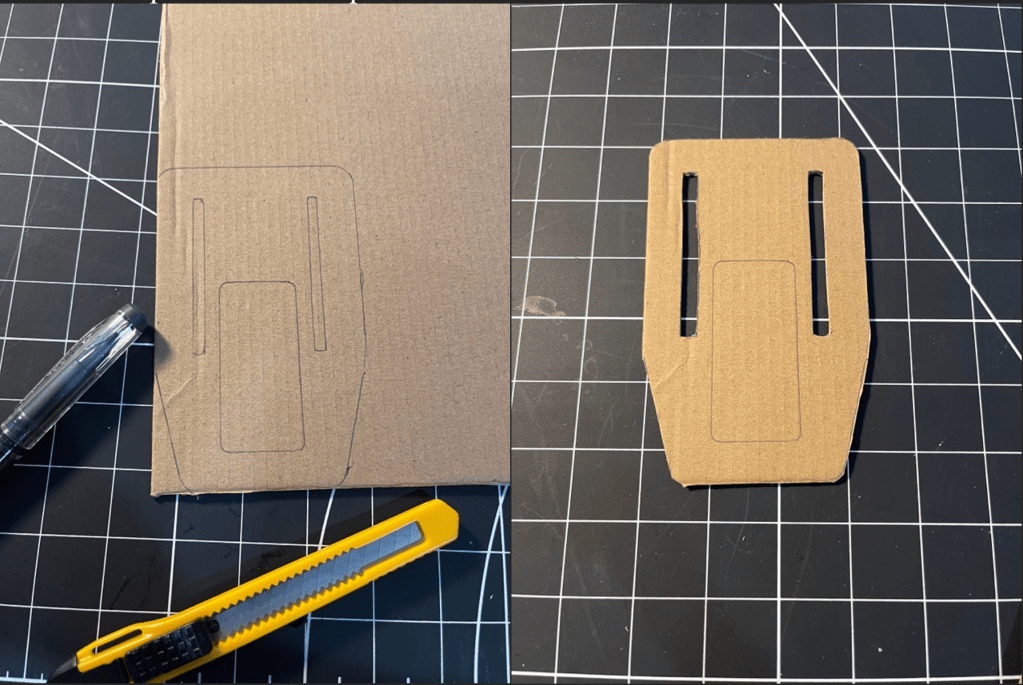
Fig 8&9: Making the first cuts
The cardboard is then installed onto the strap to test for fit.
The strap itself required modification as well, since it was used to hold a rolled up mattress, it needs to be shortened. This is done by cutting out 1/3 of the strap’s length.
While working on it I decided to also add elasticity, as this allows the strap to apply constant tension. The elastic came from a section of a bungee cord, which is sewn onto the strap.
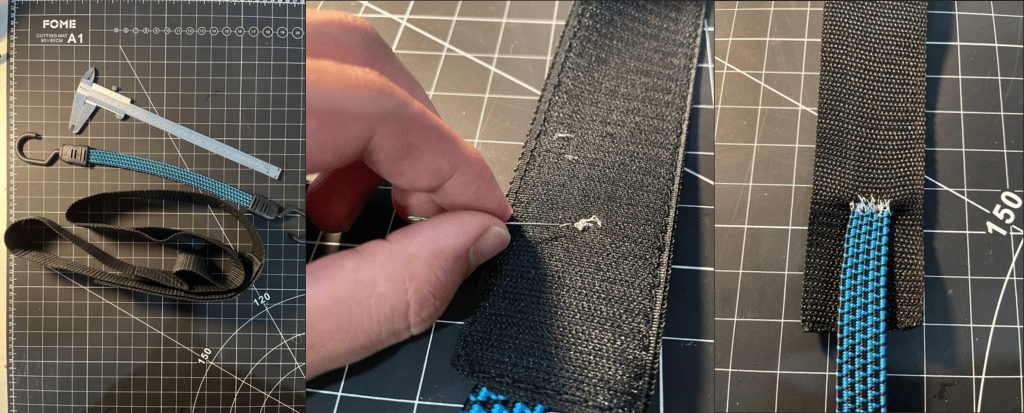
Fig 10, 11, 12: Sewing on the bungee cord.
I then glued the gopro receiver onto the center section, which is also marked on the paper template, allowing it to be perfectly aligned. And the mark one component is complete. See Fig.13.
Testing Process – MK1
The test focuses on two things: Function and Durability. And it is conducted at my local archery range. The durability component of the test consists of the continuous mounting and dismounting onto/off of trees of varying diameters, at different heights.
Functionally speaking the treecam offers more convenience than a tripod when used in a forest environment. It simply folds away and fits in your pockets, more realistically though, your backpack. It weighs almost nothing, surpassing the tripod by a long shot. The strap worked as intended, mounting and dismounting was quick and easy, and the bungee cord held tension – The treecam does not move at all once mounted. The GoPro mount allowed me to mount three different cameras onto it – a phone, a dji osmo, and an insta360 onex2 camera, which is the heaviest. Because of the lowered camera position, It did not twist the belt. Since it began to rain, I mainly used the dji osmo.
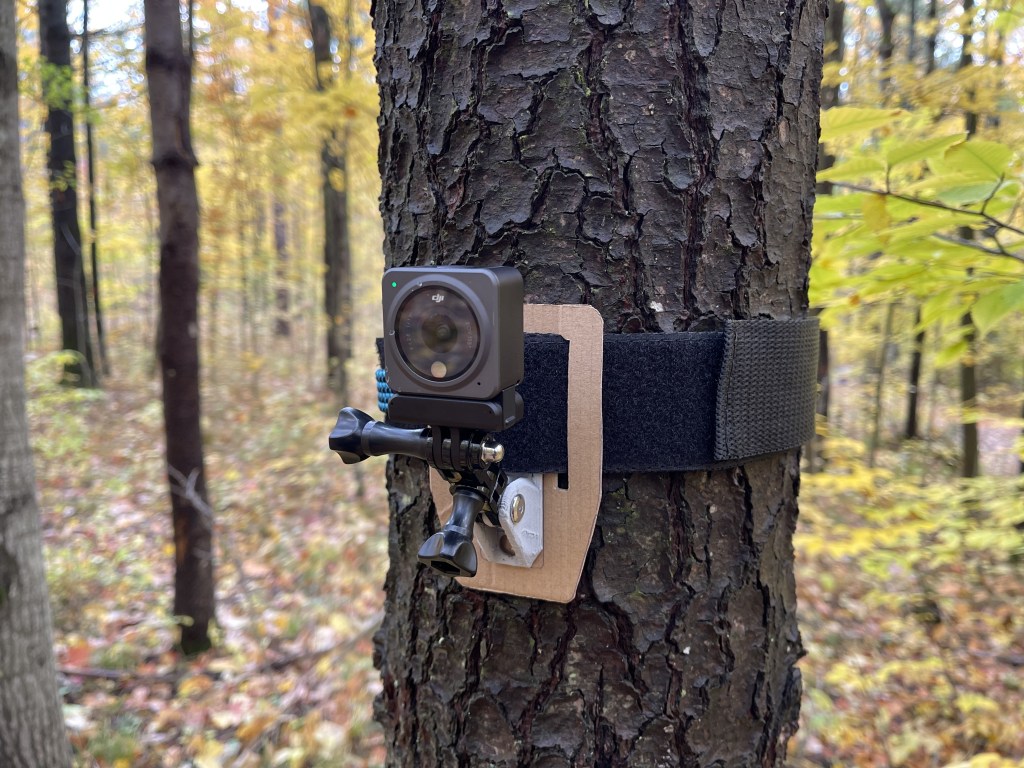
As you can see in this photo (Fig. 13), the cardboard had some wrinkles, suggesting a lack of stiffness. Other than that, the treecam met its design objectives.
Durability was a key concern for the mark one, as it is made of a piece of cardboard. It began to rain during the first trial, although the trees themselves were not particularly wet, the cardboard became noticeably moist after some uses. Tears were also noticed along the cutouts for the strap, this can be attributed to:
- Cardboard being weakened after becoming wet;
- The weight of the camera;
- Stress caused by the continued mounting and dismounting.
This indicates a lack of reliability in wet conditions, and failure is expected in the long run.
Fig. 14: Rain droplets bouncing off the camera during its first test.
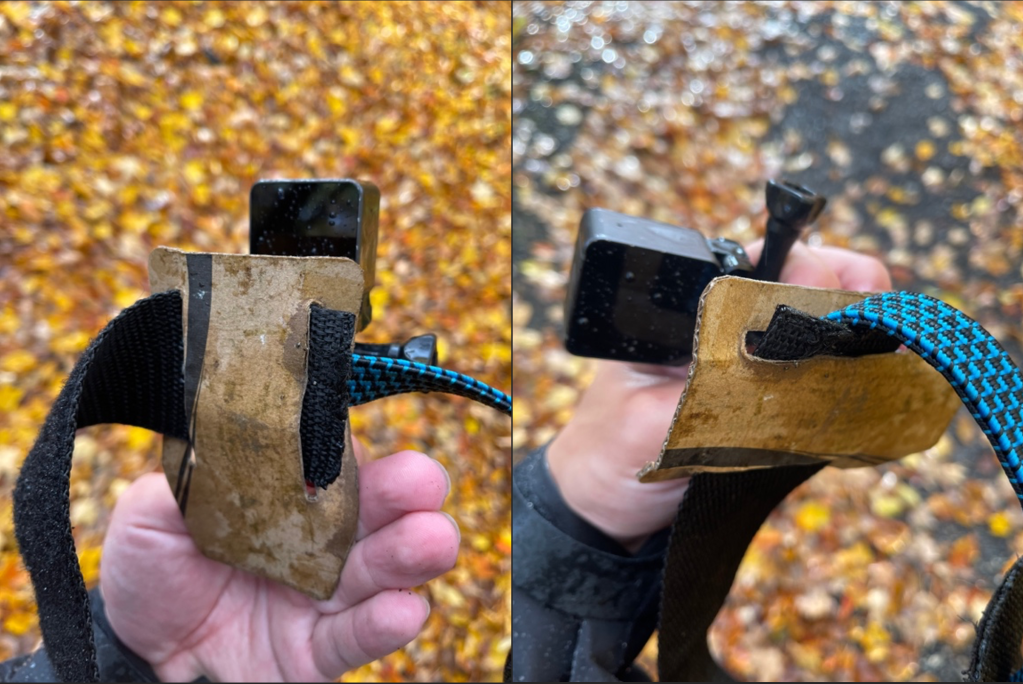
Fig 15&16: Moisture damage to the cardboard. Note the tears around the belt.
Refinement, and Mark Two
We now know that cardboard is not ideal in wet conditions. To combat this issue two approaches are available: One, apply a coating of sorts to ensure seal; Two, make it out of a different type of material.
I had foam sheets in mind (essentially, two layers of paper with a foam layer in between them). This board has the same thickness of cardboard, but its foam core is much stiffer.
Foam boards are still covered by paper, and prolonged exposure to moisture will still weaken it. So I decided to adopt a mixed approach – by using foam boards, but also cover its surface with duct tape. This method best conforms to an assembly line flow – board gets cut, reinforcement tape gets applied, then the GoPro mount is glued on.
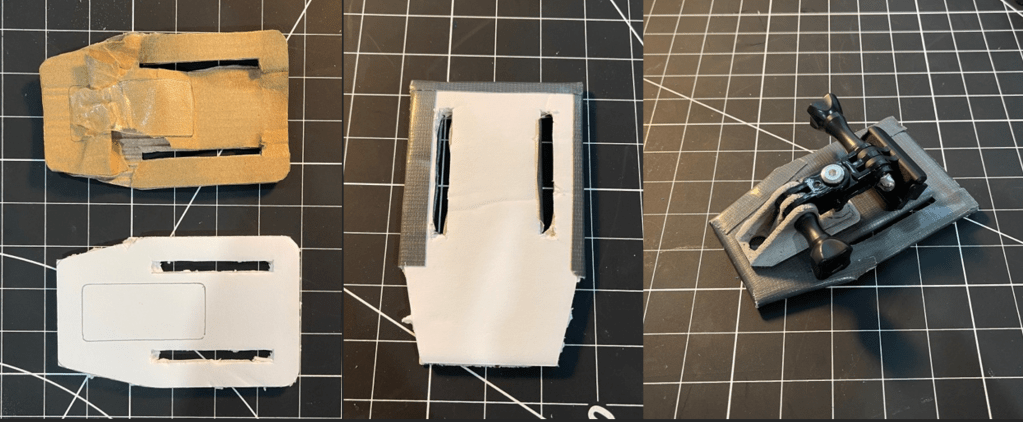
Fig. 17, 18, 19. Left: Comparison to cardboard; Center: Duct tape being applied; Right: MK II completed
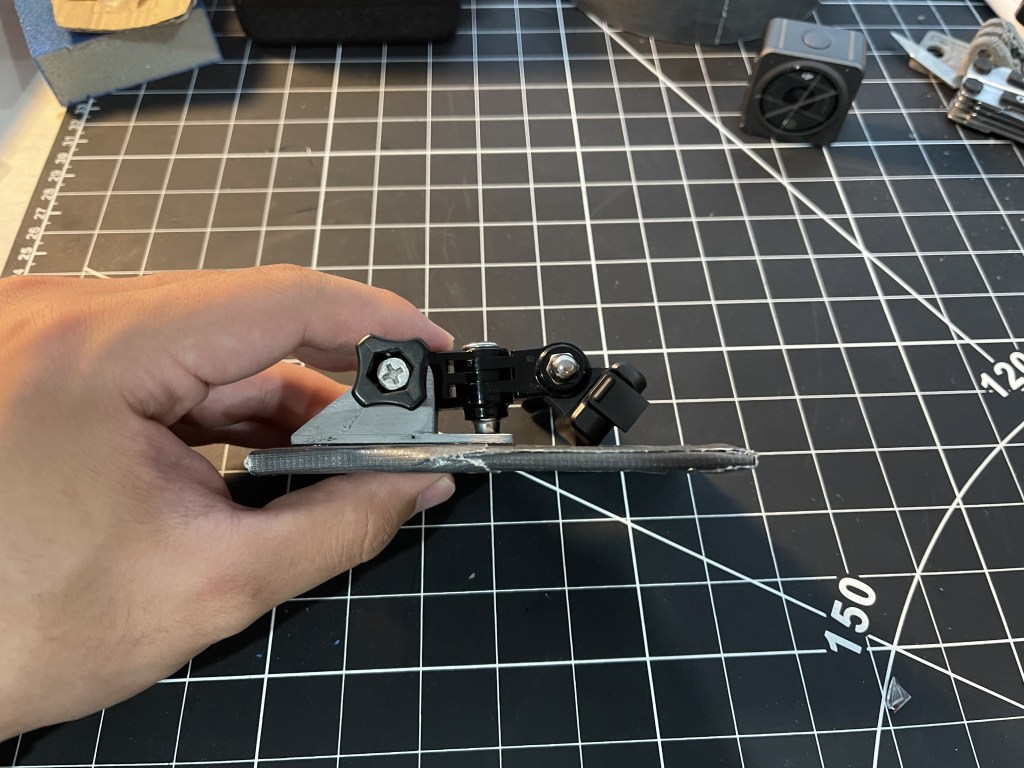
Fig.19-1: MK-II folded up when not in use. Making it more compact.
Testing the MK-II
The mark two retains all the features from the mark one, while being significantly more durable.
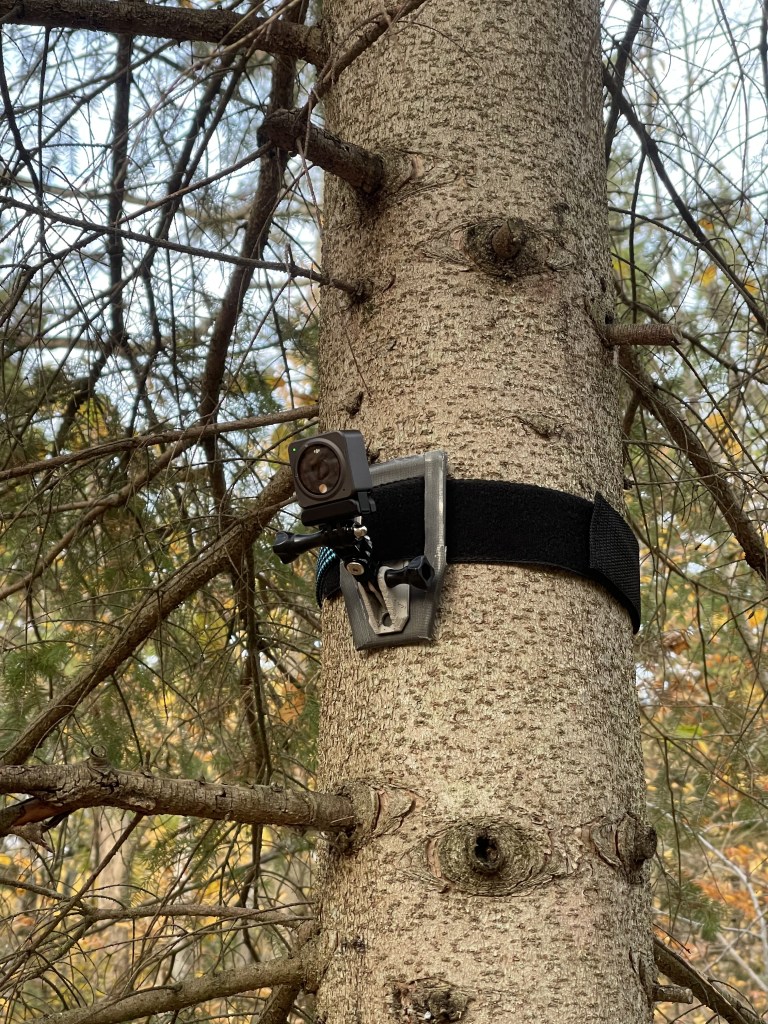
Photo of the mark two in action. Mounted 2.5 meters above ground – beating most tripods in that regard
—
During testing I noticed the TreeCam had more features than initially planned. I discovered many of them while conducting the second and third trial of the MK-II. For example, the strap can be attached to the exterior of my backpack, saving backpack space, as well as the time of opening and closing it:
Other features include:
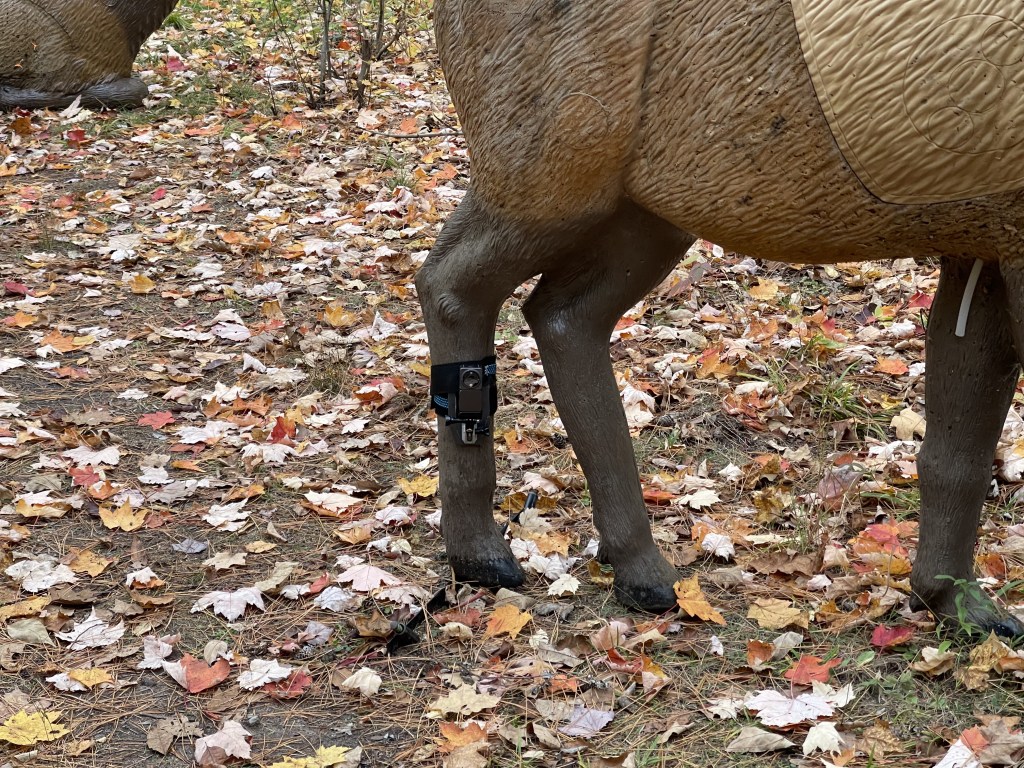
Of course, it doesn’t just strap onto trees. This is a dummy animal, which now acts as a tripod (or monopod).
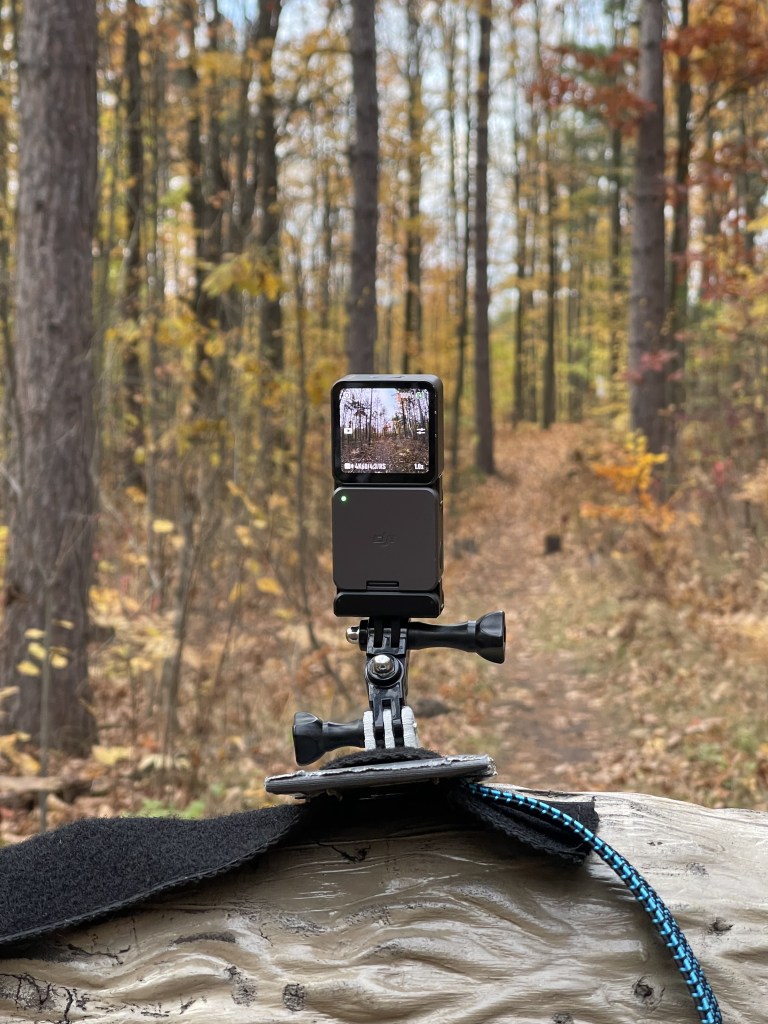
The base plate acts as a stand of sorts, which allowed the camera to be placed on (relatively) flat surfaces, in addition, note how the base plate is tilted relative to the camera, this adjustment allows the camera to stay level even when the surface isn’t.
More Testing Footage
Here is a simple compilation of videos recorded with MK-1 and MK-2 Treecams:
Mid-Project notes
While I was testing the mark-II I discovered that there are several existing products which had similar features to mine:
- Trail cameras: Used primarily for hunting, and is attached to a tree by a strap. Trail cameras are usually one piece, meaning, their straps are permanently connected to the camera housing and is not compatible with other cameras. Prices range from 100 to 500+ (https://www.digitalcameraworld.com/buying-guides/best-trail-cameras)
- Outdoor camera arms: Also mounted onto a tree via a strap, but they require a large lead screw which is drilled into the tree for stability. Because of the long, metal arms, they are significantly heavier too. Priced around 100 or more. (https://www.gomuddy.com/camera-arms-muddy-outdoors/)
- After doing some more research, it turns out that people have created mounts similar to the first “claw” design as well – using a single large screw which drills into the tree, at the other end of the screw is a different screw for the camera. A device like this lacks flexibility, only cameras with threaded mounts can be used; and once installed, you cannot tilt it left or right. (https://www.youtube.com/watch?v=QjTPa-Jtunc&ab_channel=JaseOutdoors)
This brings up the notion that no matter how original an idea is, chances are, someone has had that idea, or a variation of that idea before. Despite this, The TreeCam is unique in its own ways: It’s universal, it does not damage the tree, it is light, small, and most importantly, it is inexpensive.
Conclusion
The TreeCam met and exceeded all of the design goals and requirements. Not only did it retain the features of a tripod while being extremely light, it has also surpassed tripods (feature and cost wise) in many ways, such as having a virtually non-existent height limit, and super quick adjustments.
Fabrication was the quickest part in this entire process. Testing and figuring out what needs to be improved took a lot of investment. If its designed for the forest, then it must be tested in the forest – for example, cardboard products are great for the environment, but under certain conditions, they’re simply not strong enough for the job, and this conclusion is made possible by product trials.
Pragmatically speaking, this product would have been perfectly manufactured with a tough material like nylon or PET in 2 hours with a capable 3d printer. But that isn’t the point. I am glad I didn’t use FDM 3d printing, not because it violates grading criteria, but because, it brought me back to my childhood, where cad and 3d printers and laser cutters were out of reach and wasn’t even a thing. When All I had was some cutting tools, and a bunch of scrap cardboard. Even hot glue guns were a luxury. Making things by hand, out of passion, can really bring quality to a product, even if it is made with rudimentary materials – because it makes you do the best with everything you have.
To conclude, it was a blast making and testing the TreeCam, it really makes one appreciate the level of technology we have available in 2022.
-
Subscribe
Subscribed
Already have a WordPress.com account? Log in now.
 Stephen's Blog